Free protein intake calculator

Protein Calculator

Find your daily protein target based on your body weight and goal, with a useful suggested range when it applies.

kg

Choose your goal. Your daily protein target will adjust.

Free to use. Your weight and goal stay in this browser.

Intended for generally healthy adults. Pregnancy, breastfeeding, kidney disease, older age and some body-composition or training circumstances may change protein needs. This calculator cannot replace individual dietary or medical guidance.

How to calculate your daily protein intake

Wondering how to calculate protein needs? Start with your body weight and a protein factor matched to your goal. This protein calculator by weight works with either kilograms or pounds; the factor changes with the unit, but your daily target in grams stays the same.

The formula

Body weight × protein factor = daily protein target

Example · Muscle gain

80 kg × 2.0 g/kg = 160 g/day

In pounds: 176 lb × 0.91 g/lb ≈ 160 g/day

Protein targets depend on your goal

Your goal changes the amount of protein you may want to plan for. Compare the values below, then choose the matching setting in the calculator. Both unit systems describe the same intake.

Goalg/kgg/lb
Everyday health0.80.36
Regular exercise1.4–2.00.64–0.91
Muscle gain / strength training1.6–2.20.73–1.00
Weight loss1.2–1.60.54–0.73

All values are grams of protein per unit of body weight, per day. The calculator uses 1.6 g/kg for regular exercise, 2.0 g/kg for muscle gain and 1.4 g/kg for weight loss as practical targets within these ranges. The muscle-gain band is a research-based planning range rather than an official ISSN recommendation; sources appear below.

Goal: muscle gain

How much protein do you need to build muscle?

Strength training and enough protein work together to support muscle growth. Macroful uses 2.0 g/kg per day, or about 0.91 g/lb, as a practical muscle-gain target. This is consistent with the upper end of the ISSN's general recommendation for exercising adults.

The suggested range gives you room to plan around your training and routine. In a meta-analysis of 49 studies, Morton and colleagues reported that additional gains in fat-free mass from higher protein intake began to level off around 1.6 g/kg. That finding was uncertain, which is why the calculator presents a range alongside a clear daily goal.

Progressive resistance training and sufficient overall energy are important too. You can read how we selected the target in the research and calculation sources.

Goal: weight loss

Protein needs during weight loss

When you're losing weight, getting enough protein can help support lean-mass retention. Macroful uses 1.4 g/kg of body weight per day, or about 0.64 g/lb, as a practical starting target informed by weight-management research.

This protein calculator helps you plan protein, not your calorie deficit. To work out how many calories to eat, use our Calorie Deficit Calculator. If you also lift weights or have specific dietary needs, your ideal planning range may differ.

Use your daily protein target

Your result applies to the whole day; you do not need to assign a fixed amount to every meal.

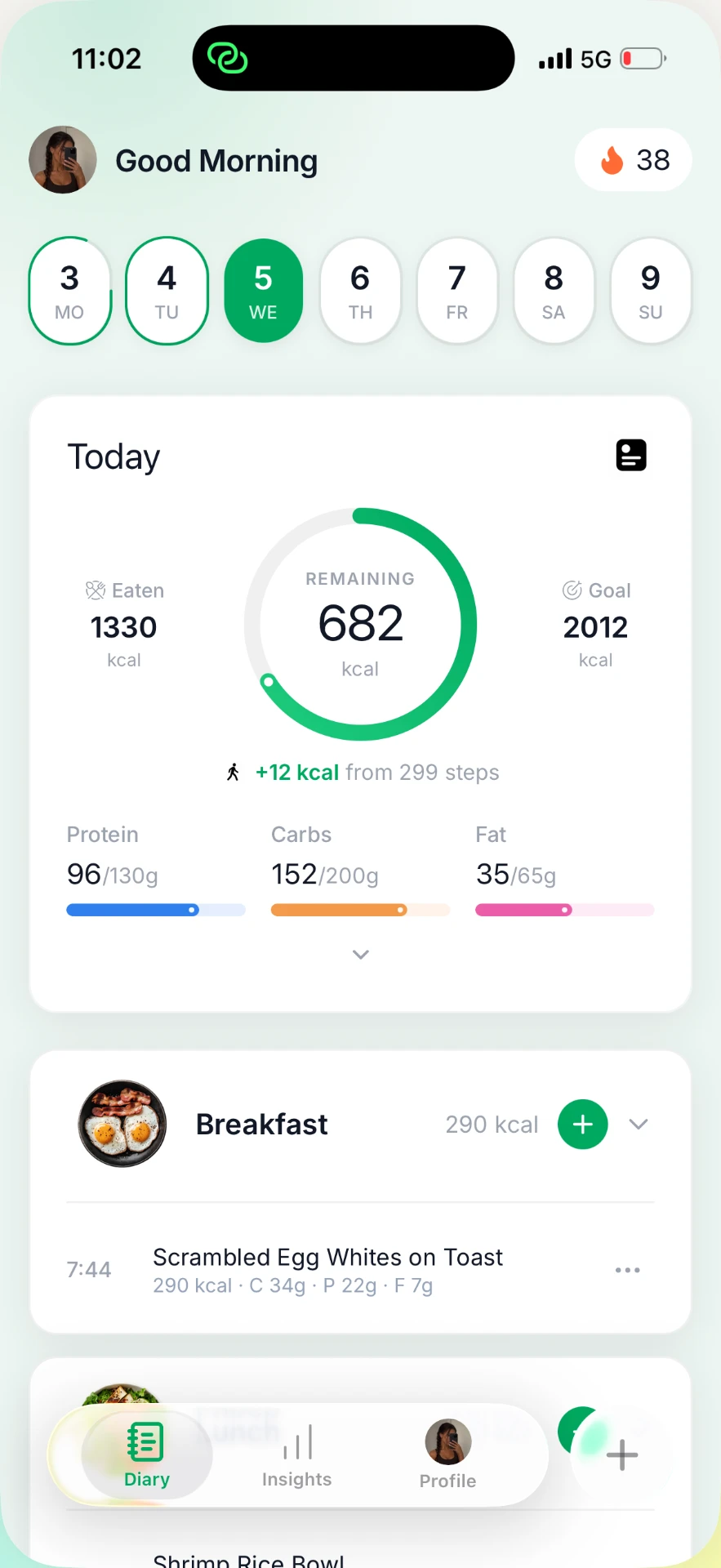
Before changing what you eat, log three days that reflect your normal routine, including a busier day. Compare each day's protein total with your target and notice where your intake tends to fall short. You can log food from a photo in Macroful and review protein alongside calories, carbs and fat. When you eat packaged foods, check the serving size and protein amount on the nutrition label.

If you often finish below your goal, change one part of your routine you can repeat. For example, if lunch is consistently low in protein, decide on its protein source when you plan or order it. Track the next few lunches to see whether that change brings your daily total closer to your goal.

Run the calculator again if your weight or goal changes. If you also want targets for calories, carbs and fat, use the Macro Calculator.

Macroful diary showing protein, calories, carbohydrates and fat
Macroful App

Protein calculator: common questions

How much protein do I need each day?

Your daily target depends on your weight and goal. For general adult nutrition, this calculator uses 0.8 g/kg as a reference. Regular exercise, muscle gain and weight loss have separate goal-based settings, so choose the one that fits you.

How much protein should I aim for to build muscle?

For muscle gain, Macroful uses 2.0 g/kg (about 0.91 g/lb) per day for people who strength train. Enter your weight in the calculator to see that target in grams.

Why does the muscle-gain range go up to 2.2 g/kg?

The wider range reflects variation and uncertainty in strength-training research, including the meta-analysis by Morton and colleagues. The upper end is a planning reference, not a requirement for everyone. The study details are explained below.

How much protein per pound of body weight do I need?

The factor depends on your goal. For example, the muscle-gain target is about 0.91 g of protein per pound, equivalent to 2.0 g per kilogram. You can compare other goals in the table above.

Do women and men need different protein calculations?

This protein calculator for women and men uses body weight and goal rather than separate factors by sex. Pregnancy, breastfeeding and some health conditions can change individual protein needs.

What if I have a higher body weight?

Protein requirements also depend on body composition. In some cases, multiplying total body weight by a standard factor can overstate a suitable target. A registered dietitian can help choose the most useful weight basis.

How accurate is my protein result?

It's a practical target calculated from your weight and chosen goal. It doesn't measure your individual requirements or account fully for medical conditions, body composition and training intensity.

Research behind your protein target

The sources below explain the reference values and planning ranges used for each goal.

Everyday health

For general adult nutrition, we use the National Academies' reference of 0.8 g/kg per day. Other nutrition authorities may use slightly different reference values. This setting is separate from the targets used for training.

Exercise and muscle gain

The International Society of Sports Nutrition (ISSN) recommends 1.4–2.0 g/kg per day for most people who exercise. Both exercise targets shown above sit within that range.

Morton et al. (2018) reported a possible breakpoint near 1.62 g/kg in a meta-analysis of resistance-training studies. The 95% confidence interval ranged from 1.03 to 2.20 g/kg, and the breakpoint model was not statistically definitive (p = 0.079). This is why the calculator displays a broader 1.6–2.2 g/kg planning range for muscle gain. That range is our interpretation of the research, not an official ISSN range.

Weight management

A review by Leidy et al. (2015) discusses higher-protein approaches in the 1.2–1.6 g/kg range during weight management. We use 1.4 g/kg as a straightforward daily starting point. Protein planning can support lean-mass retention, but calorie intake, activity and individual circumstances also matter.
Scientific references

  1. National Academies. Dietary Reference Intakes: Protein.
  2. Jäger R et al. (2017). International Society of Sports Nutrition Position Stand: Protein and Exercise. Journal of the International Society of Sports Nutrition. DOI: 10.1186/s12970-017-0177-8.
  3. Morton RW et al. (2018). Systematic Review, Meta-Analysis and Meta-Regression of Protein Supplementation with Resistance Training. British Journal of Sports Medicine. DOI: 10.1136/bjsports-2017-097608.
  4. Leidy HJ et al. (2015). The Role of Protein in Weight Loss and Maintenance. American Journal of Clinical Nutrition. DOI: 10.3945/ajcn.114.084038.

From goal to everyday progress

Know your protein target. See how your meals add up.

Macroful

Simple food logging, all in one place.

Download on the App Store